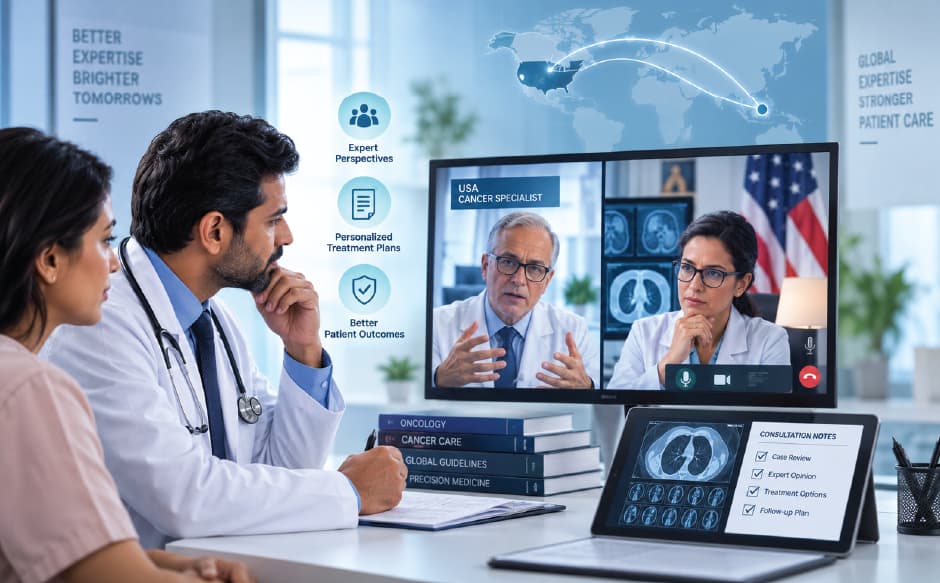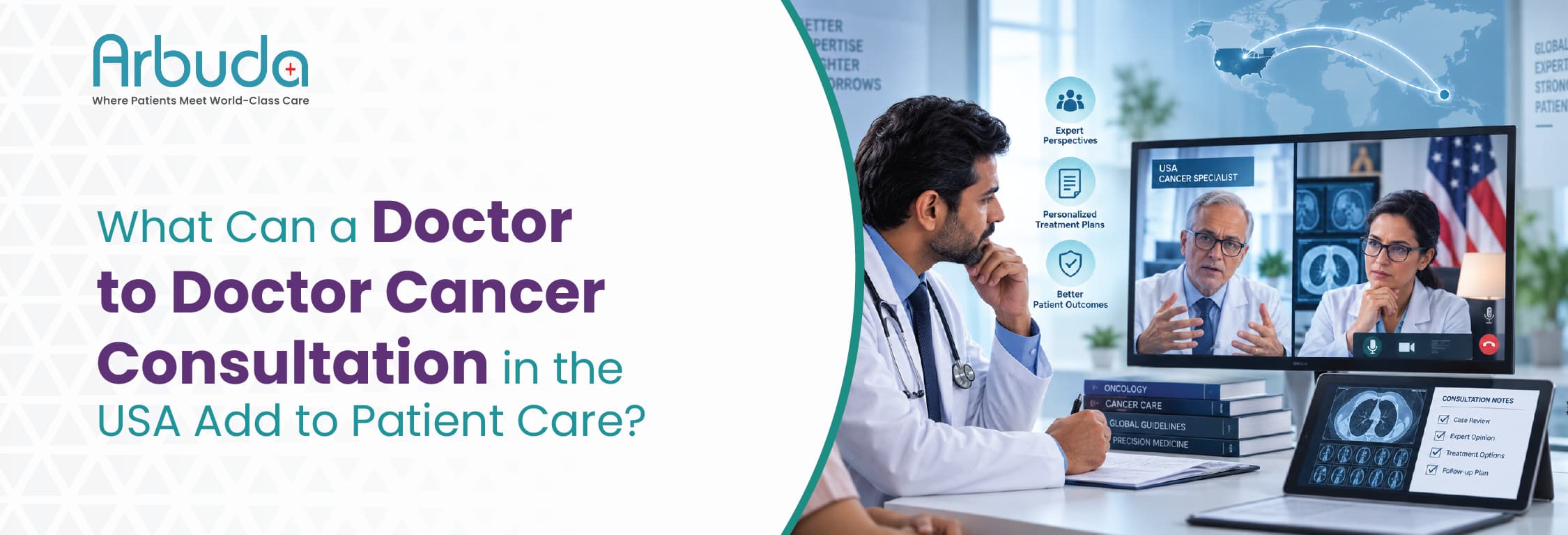

An online expert opinion allows you to have your diagnosis and treatment plan reviewed by an additional cancer specialist without travelling for an in-person appointment. This can be especially useful when you are unsure about your diagnosis, treatment options, or whether surgery, chemotherapy, radiation, or another approach is right for you.
The process is usually straightforward: you and your treating physician share your medical records, a US oncologist reviews them, and you receive an independent expert opinion that gets added to your existing care plan.
This article walks through what an online expert opinion actually involves, what a US oncologist reviews when the consult happens remotely, how the process works step by step, and where a platform like Arbuda fits if you're doing this from outside the United States.
What Counts as an “Expert Cancer Opinion,” Exactly?
A expert opinion is a focused, independent review of a diagnosis and treatment plan that has already been made, it's not starting your workup over. Typically it involves:
- Re-reading the pathology (the biopsy slides, not just the report)
- Re-reading the imaging (CT, MRI, PET scans)
- Reviewing the proposed treatment plan against current clinical guidelines
It's different from a routine follow-up visit (which tracks a plan already in motion) and different from a hospital's internal tumor board (which reviews a case within one institution). An expert opinion is deliberately external, a different set of specialists, often at a different institution, sometimes in a different country, looking at the same case with no prior stake in the original recommendation.
Why Patients Increasingly Seek Expert Cancer Opinions Online
Ten years ago, "getting an expert opinion" usually meant booking a flight, taking physical films and slides, and sitting in a waiting room at a cancer center thousands of miles from home. That's changed. Digital pathology scanners can produce whole-slide images sharp enough for remote review, PACS systems can transmit full DICOM imaging securely, and video consultations have become a normal part of oncology care rather than a pandemic-era workaround.
Patients who most commonly look for an online expert opinion include:
- Someone newly diagnosed and weighing a major decision (surgery vs. active surveillance, mastectomy vs. lumpectomy, chemo protocol A vs. B)
- Patients with a rarer cancer subtype where local expertise is thin
- Anyone who's received two conflicting recommendations already
- Patients outside the US or in regions with fewer sub-specialized oncologists, who want a US-trained oncologist's read before committing to a plan or before deciding whether traveling for treatment is even necessary
Why Choose a US Oncologist for an Expert Cancer Opinion?
A US oncologist can offer more than just another review of your diagnosis. The potential value comes from access to highly specialized cancer expertise, established treatment guidelines, and experience with complex cases.
-
A large network of specialized cancer centres: The US National Cancer Institute currently recognizes 74 NCI-Designated Cancer Centers across 37 states and Washington, D.C. These centres are selected for their research capabilities and resources in cancer prevention, diagnosis, and treatment.
-
Specialized oncology expertise: Major US cancer centres commonly organize care around specific cancer types and treatment areas. For an expert opinion, this can be useful when the diagnosis is uncommon, the cancer is advanced, or several treatment approaches are possible.
-
Evidence-based treatment guidance: US cancer specialists may use established evidence-based guidelines, including those developed by leading oncology organizations, when assessing staging and treatment options. The goal is not simply to offer another opinion, but to determine whether the diagnosis and proposed treatment fit current evidence.
-
NCCN Guidelines: The reference most oncologists worldwide already work from, are developed in the US. The National Comprehensive Cancer Network (NCCN), an alliance of leading US cancer centers, publishes the clinical practice guidelines that oncologists in dozens of countries use as a benchmark for staging and treatment decisions. When a US oncologist reviews your case "against guidelines," this is very often the specific standard being applied, which is also why a US-based review can be useful even if your treatment ultimately happens elsewhere.
-
Online expert opinions are already an established model: Dana-Farber Cancer Institute, an NCI-Designated Comprehensive Cancer Center, offers a formal online expert-opinion service. Its process includes matching a patient's case with an appropriate medical oncologist, reviewing medical records and reports, and providing a written opinion. Once all required records are collected, Dana-Farber says the written opinion typically takes 7–14 business days.
For international patients, this model can be particularly practical. Dana-Farber states that its online expert-opinion program allows eligible patients outside the US to receive an expert review without travelling, although records from non-US facilities may need to be provided and professionally translated into English.
A US oncologist is therefore not automatically a better choice than a specialist in another country. The value of the expert opinion comes from accessing another qualified, specialized perspective that can confirm your current plan, identify additional options, or raise questions worth discussing with your treating team.
If you want this additional perspective without travelling to the US, an online review can make access to a US oncology specialist much simpler. Get a US Oncology Expert Opinion Through Arbuda
Your doctor doesn't have to change. Your care team gets stronger. With Arbuda USA, patients and their treating physicians can submit medical records, pathology, and imaging for expert review by a US oncology specialist remotely. The process adds a qualified specialist perspective to your existing care team before major treatment decisions are made, while your local oncologist continues to lead your care.


What a US Oncologist Actually Reviews in an Online Expert Opinion
This is the part patients are usually least prepared for, a proper expert review is not just “the doctor reads your discharge summary.” It's a re-examination of the underlying evidence.
| Document type | What's actually reviewed | Why it matters |
|---|---|---|
| Pathology | The physical biopsy slides (not just the typed report) | Pathology discrepancy rates in published reviews range from roughly 1.3% to nearly 15% depending on cancer type, and are highest in lymphoma, sarcoma, brain, skin, and gynecologic cancers |
| Radiology/Imaging | CT, MRI, PET scans, original images, not just the radiologist's summary | Staging depends heavily on image interpretation; a different radiologist can read margins, nodal involvement, or metastatic spread differently |
| Treatment plan | The proposed protocol, checked against NCCN Guidelines, ASCO recommendations, or ESMO guidance | Confirms the plan is guideline-concordant, or flags where a newer regimen, a clinical trial, or a different sequencing might apply |
Once you know the potential value of a US oncologist’s perspective, the next question is how to access it without adding unnecessary travel, time, and expense.
Expert Opinion Online vs. Traveling Abroad for a Consult
Both options can give you access to specialist expertise, but the practical differences in time, cost, travel, and the consultation process are worth considering before you decide.
| Traveling for an in-person opinion | Online expert opinion | |
|---|---|---|
| Time to first input | Weeks (visa, travel, appointment scheduling) | Days to ~2 weeks |
| Cost exposure | Flights, lodging, time off work, often for the family too | Cost of the review service only |
| What's reviewed | Same materials; pathology, imaging, treatment plan | Same materials, submitted digitally |
| Best used for | Confirming a decision to actually relocate for treatment | Deciding whether travel or a plan change is warranted in the first place |
Neither route is inherently better, they answer different questions. An online review is usually the more efficient way to find out if travel is even necessary before committing to it. Once you decide that an online expert opinion makes sense, the next step is choosing a service that can connect you with the right specialist and manage the review process.
Get a US Cancer Expert Opinion Through Arbuda
Arbuda USA is a patient-navigation platform that expands your cancer care team by connecting you and your treating physician with additional US oncology specialists for an expert opinion and treatment guidance. We don't replace your oncologist, we add expertise to your oncology team. Arbuda does not provide cancer treatment itself; its role is to facilitate specialist review and, when needed, help coordinate care in the US.
Here is what the process looks like: ● Submit your case online: You provide your medical history, reports, scans, and other relevant records through the online intake process.
● Get matched with relevant expertise: Arbuda says its network includes 1,400+ doctors and 150+ partner institutions, covering multiple cancer specialties.
● Choose the level of review: Its General Guidance service lists a 24–48-hour turnaround, while its Oncology, Pathology, and Radiology reviews list a one-week turnaround. The Comprehensive Service, which combines radiology, pathology, oncology and surgical oncology review, lists a two-week turnaround.
● Receive an expert opinion: Depending on the service, the review can assess your diagnosis, pathology, imaging, and proposed treatment plan. Recommendations are shared with both you and your local physician, so your treating doctor stays informed and can continue leading your care.
● Your local physician continues your care: In most cases, your treating physician continues managing your care with the added clarity from the expert review. Arbuda steps in further only when specialized treatment, a clinical trial, an advanced procedure, or treatment at another center is appropriate, and helps coordinate that next step.
This makes the process particularly useful for patients in India, the Gulf, and Mauritius who want access to US oncology expertise before deciding whether international travel is necessary.
This is also what sets Arbuda apart from a traditional second-opinion service. Cancer care often benefits from multiple specialists weighing in, medical oncology, surgical oncology, radiation oncology, pathology, and radiology, among others, so rather than simply selling another opinion, Arbuda builds an extended oncology care team around the patient, working alongside the treating physician instead of around them.
You can start by sharing your case documents through Arbuda's secure intake process, or if you have questions first, chat with the Arbuda team on WhatsApp or visit the Contact Us page to speak with a patient care coordinator before deciding what to submit.
Medical Disclaimer: This article is intended for general educational purposes only and does not constitute medical advice, diagnosis, or treatment recommendations. It should not be used as a substitute for consultation with a qualified healthcare professional. Every cancer case is different, and decisions about diagnosis and treatment should always be made in consultation with your treating physician and care team. Arbuda is a patient navigation and consultation-coordination platform; it connects patients with independent third-party medical specialists for opinions and guidance and does not itself provide medical diagnosis or treatment.