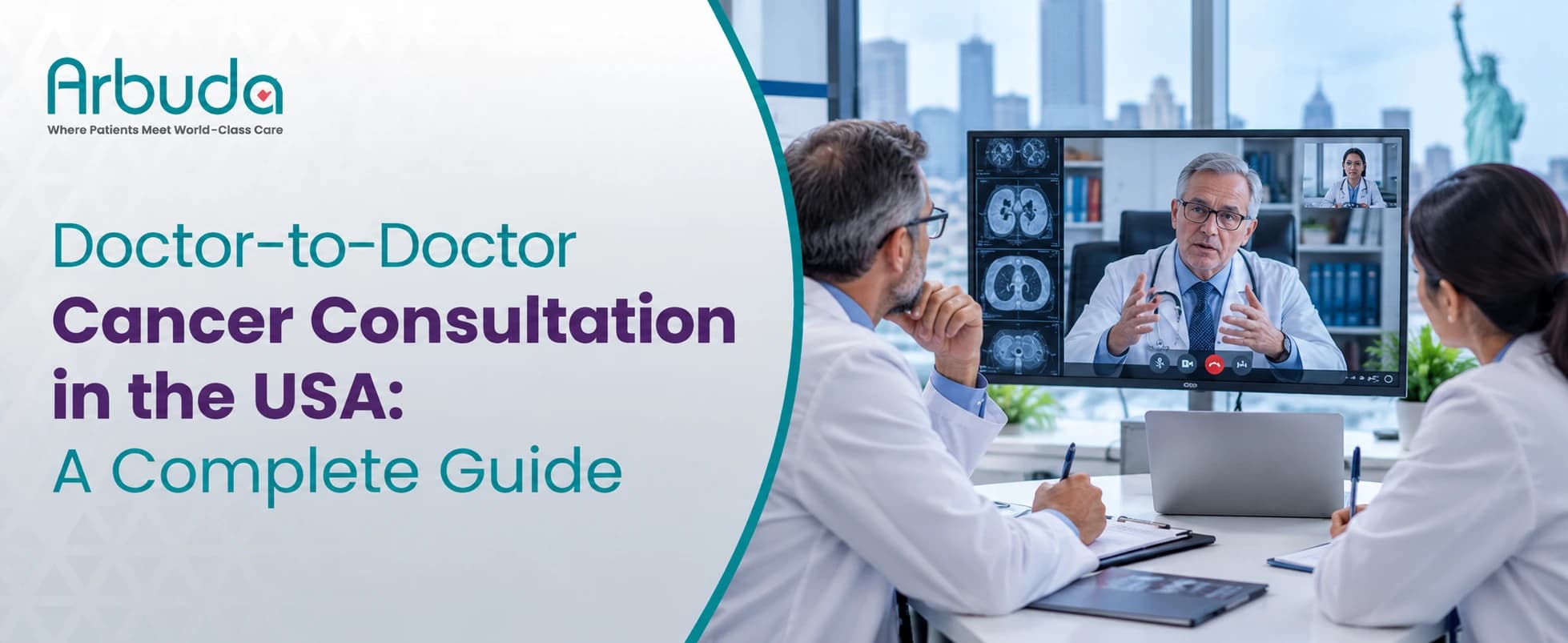

A cancer diagnosis rarely comes with certainty attached. Even experienced oncologists routinely seek input from colleagues before finalizing a treatment plan, and the data on why is striking.
That gap between a first read and a fully reviewed one is exactly what a doctor-to-doctor cancer consultation is designed to close. Instead of a patient starting from scratch with a new physician, the treating doctor, the oncologist already managing the case, connects directly with a specialist in the United States to review pathology, imaging, and staging before a plan is finalized or changed. For patients outside the US, particularly across the Gulf and Middle East, this model has become one of the fastest-growing ways to access American oncology expertise without relocating for care.
This guide breaks down what a doctor-to-doctor cancer consultation actually involves, when it's worth requesting, what the process looks like end to end, and how a patient navigation platform like Arbuda fits into that picture.
What Is Doctor-to-Doctor Cancer Consultation
Doctor-to-doctor consultation in oncology is a confidential discussion between two or more cancer specialists who review your case to reach a shared clinical opinion. Your primary oncologist may initiate this conversation to confirm a diagnosis, explore alternative treatments, or discuss whether your care is on track. The consulting oncologist reviews all your medical information, pathology reports, imaging scans, blood work, and treatment history, before offering their expert perspective. This peer-review process helps ensure that complex cancer diagnoses and treatment plans reflect the latest medical evidence and the experience of multiple specialists.
Unlike a traditional patient visit, you don't sit in a consultation room; instead, the doctors communicate directly using secure medical channels, often in real time or asynchronously depending on urgency. The outcome is a shared recommendation that gets fed back to your treating team, helping your doctors make the best possible decision for your care.
How It Differs From a Standard Patient Second Opinion
A patient-initiated second opinion typically means the patient personally seeks out a new doctor, often disconnected from their existing care team. A doctor-to-doctor consultation keeps the original oncologist central to the process. The local physician requests the review, receives the findings, and decides, together with the patient, how to apply them. This distinction matters clinically: care stays continuous, and the patient isn't asked to choose between two competing doctors.
Why Oncologists Use Peer Consultation for Cancer Cases
Cancer diagnosis and treatment involve many variables, tumor type, stage, genetic markers, patient age, overall health, that demand expertise from multiple specialists. A single oncologist, no matter how skilled, benefits from a second medical opinion when the case is complex, rare, or when treatment outcomes are uncertain. Peer consultation allows specialists to pool knowledge, discuss difficult diagnostic questions, and validate treatment plans before your care proceeds.
International collaboration is especially valuable because cancer specialists in different regions may have access to newer techniques, clinical trials, or treatment protocols that are not yet available locally.
When your local doctor consults with a specialist in another country, you gain access to a broader perspective without needing to travel immediately or change your primary care team. This approach is standard practice in cancer centres worldwide and reflects the principle that the most challenging cases deserve the most informed decision-making.
When Should a Doctor-to-Doctor Cancer Consultation in the USA Be Considered?
Not every diagnosis needs an additional layer of review, but certain situations consistently benefit from one:
-
Rare or unusual cancer types, where the local treating team may see very few comparable cases in a given year.
-
Discordant pathology or imaging readings, where two local specialists disagree on the diagnosis.
-
Borderline or complex staging, where the choice between surgery, systemic therapy, or radiation first depends on precise imaging interpretation.
-
Consideration of clinical trials or advanced therapies not yet widely available outside the US.
-
Before a major, irreversible treatment decision, such as extensive surgery or a treatment regimen with significant side effects.
-
Cross-border care coordination, where a patient plans to travel for part of their treatment and needs the receiving specialist's input before departure.
How the Doctor-to-Doctor Cancer Consultation Process Works
The mechanics are fairly consistent across academic cancer centers and coordination platforms, even if the packaging differs.
-
Case submission, the treating physician or a coordinating platform compiles pathology reports, slides or scanned slide images, radiology studies (often on disc or via a secure portal), lab results, and a clinical summary.
-
Specialist matching, the case is routed to a US oncologist, pathologist, or radiologist whose subspecialty matches the diagnosis (e.g., a GI oncologist for a pancreatic case, a breast pathologist for a breast biopsy).
-
Independent review, the US specialist reviews the material without simply repeating the original workup, applying current guideline-based standards from sources such as NCCN, ESMO, or the National Cancer Institute (NCI).
-
Written findings, a report is generated, typically covering diagnostic confirmation or revision, staging assessment, and treatment recommendations.
-
Return to the treating physician, findings go back to the local oncologist first, who discusses them with the patient and decides how to incorporate them into the existing care plan.
What's Typically Needed at Each Stage
| Stage | Records Typically Required |
|---|---|
| Pathology review | Physical slides or high-resolution digital scans, original pathology report |
| Imaging review | CT/MRI/PET scans on disc or via secure upload, radiology reports |
| Clinical context | Referral letter, treatment history, relevant lab work, genetic testing (if done) |
| Report delivery | Secure portal access or encrypted document, typically shared with both patient and treating physician |


What Information Doctors Share During Consultation
During a doctor-to-doctor consultation, oncologists exchange detailed clinical information to ensure the consulting specialist fully understands your case. Your pathology report, which describes the cancer cells under a microscope and includes important molecular markers, is always included. Imaging studies such as CT, MRI, or PET scans are shared in their original digital format so the consulting doctor can review them independently. Laboratory results including tumor markers, genetic testing (if performed), and blood counts are essential for understanding your baseline health and cancer biology.
Your full medical history, including any previous cancers, family history of cancer, previous treatments you have received, and any side effects or complications, helps the specialist assess whether you have any special considerations. The consulting oncologist may also want to know about your overall fitness, any other medical conditions (heart disease, diabetes, kidney problems), and your personal preferences regarding treatment intensity.
This comprehensive information allows the consulting specialist to offer truly personalized advice grounded in a complete picture of your health.
Benefits of Specialist-to-Specialist Cancer Review
Specialist-to-specialist consultation brings several concrete benefits to your cancer care. First, it provides diagnostic confirmation, when your cancer type is unusual or difficult to classify, a second pathologist's opinion can prevent misdiagnosis and ensure you receive treatment for the actual disease you have. Second, it offers access to the latest treatment evidence; specialists in leading cancer centres stay current with emerging therapies, clinical trials, and research findings that may not yet be widely adopted. Third, it helps reduce unnecessary treatment; sometimes consultation reveals that a proposed aggressive approach is not justified, allowing you to avoid side effects from treatments you don't actually need. Fourth, it improves treatment sequencing, when you have completed one type of therapy, consultation helps your doctors plan the next logical step based on how your cancer responded. Fifth, it supports peace of mind; knowing that your treatment plan has been reviewed by multiple experts often reduces the emotional burden of living with a cancer diagnosis. Finally, specialist consultation is invaluable if you are considering medical travel; your local doctor's partnership with an international specialist ensures a smooth transition and continuity of care.
How Arbuda Supports Doctor-to-Doctor Cancer Consultations for International Patients
This is where a platform like Arbuda USA fits into the picture, and it's worth being precise about what that role actually is. Arbuda is a technology-enabled patient navigation platform, not a hospital and not a treatment provider. It doesn't diagnose, treat, or prescribe. What it does is coordinate the doctor-to-doctor process described above: gathering a patient's pathology and imaging records, matching the case to an appropriately subspecialized US oncologist, and managing the logistics of getting an Expert Opinion report back to both the patient and their treating physician.
Arbuda USA is built specifically for patients in Saudi Arabia, UAE, Qatar, Kuwait, Oman, Bahrain, Iraq, and Mauritius who want access to US oncology expertise through online consultation and treatment guidance, without that access depending on international travel for the initial review. The model is deliberately structured as an addition to a patient's existing care team rather than a replacement for it, the treating oncologist stays central, and Arbuda's coordinators handle the parts of the process (records collection, translation, specialist matching, scheduling across time zones) that are hardest for a patient or a busy local hospital to manage alone.
For patients weighing whether to pursue a US-based review, the practical value of a platform like this is less about any single institution's name and more about reducing the friction between "I want a US specialist's input" and actually getting a complete, reviewable case in front of one, which, for many international patients, has historically been the hardest part of the process.
Questions to Ask Before Requesting a Consultation
Before initiating a doctor-to-doctor cancer consultation, it's worth raising these questions with your treating physician:
- Would a review by a US specialist realistically change my treatment plan, or is my case already following established guidelines closely?
- What specific records will the reviewing specialist need, and are they all currently available?
- How will the findings be communicated back to you, and how quickly?
- If the recommendation differs from my current plan, how will we decide which path to follow?
Preparing Your Case: Medical Records Checklist
| Record Type | Notes |
|---|---|
| Pathology slides or digital scans | Original glass slides are often preferred; digital scans accepted by many programs |
| Pathology report | Full written report, not just a summary |
| Imaging studies | CT, MRI, PET, as DICOM files or on disc, plus written radiology reports |
| Clinical/treatment history | Referral letter, prior treatments, current medications |
| Genetic or molecular testing | If performed, include full panel results |
Conclusion
A doctor-to-doctor cancer consultation isn't about second-guessing a local oncologist, it's a structured, physician-led way to bring additional subspecialized expertise into a case before a major decision is made. The evidence is consistent: reviews by specialists and multidisciplinary teams frequently refine or change the original plan in ways that matter clinically. For international patients, the barrier has traditionally been logistical, getting complete records to the right US specialist and back, rather than a lack of willingness on either side. That's the specific gap that coordination platforms like Arbuda are designed to close, keeping the local physician central while extending the case to a US specialist's review. Whether or not that step is right for a given diagnosis is ultimately a conversation to have with your treating doctor, but for complex, rare, or borderline cases, it's a question worth raising early.
Chat with our care coordination team to find out whether a doctor-to-doctor consultation could add value to your current treatment plan.
Medical Disclaimer: This article is for general educational purposes only and does not constitute medical advice, diagnosis, or treatment. Always consult a qualified healthcare professional regarding your specific medical condition. Arbuda is a patient navigation and coordination platform and does not provide medical diagnosis or treatment.